Cisco General Counsel Mark Chandler doesn't mince his words when it comes to law firms and their addiction to the billable hour:
As Cisco gets bigger, the share of revenue devoted to legal expense needs to gets smaller. Letters from law firms telling me how much billing rates are going up next year are therefore totally irrelevant to me... I don’t care what billing rates are. I care about productivity and outputs.
His speech to the Northwestern School of Law's 34th Annual Securities Regulation Institute conference describes a fundamental misalignment between most law firms (who want to sell billable hours) and most clients (who want to buy information, documents, etc, at low cost), which is leading to unhappy lawyers and unhappy clients.
But Chandler isn't just talking about the problem, he's changing things. He lists at least four areas where Cisco is now buying legal services on a fixed fee basis: patent prosecution; review of license offers; corporate secretarial work; US corporate, securities and M&A work; and US commercial litigation. In some cases, these fixed fees are structured to go down each year, not up. Cisco has also pioneered the use of internal productivity tools, like online contract drafting, so that many contracts can be created by front line staff, without the need for costly legal review.
The other way to respond to cost-cutting pressures is simply to get rid of some lawyers and stop checking low-value deals. But as Coles is discovering, this can lead to claims that you're dropping the ball on compliance.
Friday, January 26, 2007

Thursday, January 25, 2007
FSA Goes Soft on Contract Certainty
I always thought "certain" meant 100% certain. How can something be "certain" if it's only 90% certain? It just doesn't sound right. But who cares what I think. In the London insurance market, it's what the FSA thinks that matters. And it turns out that 90% certain is certain enough for them.
The two-year deadline for contract certainty in the London insurance market has now passed, and the FSA has decided that the industry has done enough to dodge the bullet of regulatory intervention.
Never mind that, strictly speaking, the goal of contract certainty has still not been met.
In its self-assessment report, the Contract Certainty Steering Committee explains things like this:
"momentum is more important than perfection..."
and this:
"contract certainty is part of a journey..."
and this:
"contract certainty was never the end game..."
They stopped short of saying "contract certainty is a nice place to visit, but you wouldn't want to live there..."
And so the journey continues.
The two-year deadline for contract certainty in the London insurance market has now passed, and the FSA has decided that the industry has done enough to dodge the bullet of regulatory intervention.
Never mind that, strictly speaking, the goal of contract certainty has still not been met.
In its self-assessment report, the Contract Certainty Steering Committee explains things like this:
"momentum is more important than perfection..."
and this:
"contract certainty is part of a journey..."
and this:
"contract certainty was never the end game..."
They stopped short of saying "contract certainty is a nice place to visit, but you wouldn't want to live there..."
And so the journey continues.
Wednesday, November 15, 2006
Are Governance Standards the Solution to IT Contract Blowouts?
An attention-grabbing article in The Australian IT starts with a couple of IT contracting horror stories, but quickly drifts off on a rather dull voyage through the alphabet soup of IT governance standards. Never mind that your contract might be full of holes. What you really need is AS-8000. And AS-8015. And AS-8016. Or AS-8018. Or BS-15000. Or maybe ISO-20000. And ISO-27001, of course.
Whatever the solution, the horror stories are classic tales of deals gone wrong:
In the first case, a sales guy won himself a big fat bonus and a nice tropical holiday by underbidding to land a mission-critical government project. Surprise, surprise, the project failed, the vendor lost $14M, and the government won a $5M damages claim to cover the costs of their manual work-around.
In the second case, a technology deal was done over a few beers in a London pub. It was supposed to cost $2M. It ended up costing over $12M. The manager responsible was fired for secretly milking funds from various accounts to bankroll his project.
Will ISO-20000 save you from these horror stories? Who knows? But a tightly drafted contract with a clear statement of work would be a good start.
Whatever the solution, the horror stories are classic tales of deals gone wrong:
In the first case, a sales guy won himself a big fat bonus and a nice tropical holiday by underbidding to land a mission-critical government project. Surprise, surprise, the project failed, the vendor lost $14M, and the government won a $5M damages claim to cover the costs of their manual work-around.
In the second case, a technology deal was done over a few beers in a London pub. It was supposed to cost $2M. It ended up costing over $12M. The manager responsible was fired for secretly milking funds from various accounts to bankroll his project.
Will ISO-20000 save you from these horror stories? Who knows? But a tightly drafted contract with a clear statement of work would be a good start.
Monday, October 30, 2006
Clean Contracting is Scary as Hell
According to the Coalition for Government Procurement (a vendor lobby group in the US), the Clean Contracting Act proposed by Democrat Rep. Henry Waxman is "scary as hell". Sounds pretty bad. So what's in this bill that has the vendor community all in a tizz?

According to a recent article in Washington Technology, the bill seeks to clean up government procurement in several ways:

According to a recent article in Washington Technology, the bill seeks to clean up government procurement in several ways:
- by banning monopoly contracts
- by reducing the use of cost-plus contracts
- by prohibiting “layer cake” deals that inflate costs through tiers of subcontractors
- by limiting noncompetitive contracts
- by increasing oversight, and preventing unjustified award fees
- by deterring corruption in contracting, and
- by closing a loophole that enables Alaska Native Corporations to receive no-bid work.
Thursday, October 26, 2006
Everything You Ever Wanted to Know About Precedent Automation
But were too afraid to ask. Precedent automation. Document assembly. Online legal services. Disruptive innovation. Precedent economics. It was all under the microscope in Sydney last week at the Precedent Automation Conference. A rare gathering (physical and virtual) of document automation experts came together to reflect on the past, present and future, and made some interesting predictions about the coming revolution in the way documents (especially legal documents) are produced, delivered and consumed.

So, are we facing a revolution in the delivery of legal documents?
Starting at the consumer end of the market, Richard Granat (dialing in from Florida) argued that web based document assembly services are already eating away at work traditionally done by small law firms, like "digital termites". Not only are some online legal solutions faster, cheaper and "good enough" compared to traditional lawyering, but in some cases they may be available for free, with online advertising funding the service. Freewilldocs.com is already experimenting with an ad-funded business model.
At a more practical level, Seth Rowland (skyped-in by video from New York) said "document assembly is like crack cocaine..." it's addictive. If you pick the right project, in the right niche, and plan and execute properly, you can get great results, and things will spread from there. On the other hand, if you don't get the planning, business model and people issues right, then you will probably be disappointed.
Canadian commentator Darryl Mountain gave a neat summary of his recent paper, Disrupting conventional law firm business models using document assembly, in which he argues that most law firms are "ripe for disruption" of the kind described in The Innovator's Dilemma. They are high performance machines, built for customized work, and, in some cases at least, resistance to document assembly will be their undoing. Darryl reckons that regulatory changes - such as relaxation of rules regarding the unauthorized practise of law and reforms giving law firms greater access to capital - could be what tips things over the edge.
Speaking of tipping, Jamie Wodetzki (that's me), asked the question: is document assembly reaching a tipping point? In other words, is it about to spread like an epidemic, where, all of a sudden, everyone's using it? Tipping Point author Malcolm Gladwell reckons that small changes to three things can cause something to tip: the idea or product itself (it must be "sticky"); the environment (which must be conducive to its rapid spread); and the people (you need mavens, connectors and sales types to get involved). My conclusions are that some sectors are starting to tip (insurance and banking), particularly where the economic and regulatory pressures are right. The rise of web-based document assembly also makes a difference. It's much more likely to spread when anyone can click on a link and it "just works".
Casting an eye to the future, Marc Lauritsen (dialing in from an undisclosed US location) longed for what he calls the "holy grail" of document assembly, where you can reassemble a document (and change answers, etc), even after it has been through a round of negotiations and random edits in Word (the good news for Mark is that this is coming in Exari v5). He also lamented the lack of rich graphical interfaces in the current crop of products, and the fact that "true" artificial intelligence still seems a long way off.
Who and where will the revolution hit first? There seemed to be a consensus that small, generalist law firms have the most to fear in the short term. And, according to Darryl Mountain, Canada is usually the last to innovate.

So, are we facing a revolution in the delivery of legal documents?
Starting at the consumer end of the market, Richard Granat (dialing in from Florida) argued that web based document assembly services are already eating away at work traditionally done by small law firms, like "digital termites". Not only are some online legal solutions faster, cheaper and "good enough" compared to traditional lawyering, but in some cases they may be available for free, with online advertising funding the service. Freewilldocs.com is already experimenting with an ad-funded business model.
At a more practical level, Seth Rowland (skyped-in by video from New York) said "document assembly is like crack cocaine..." it's addictive. If you pick the right project, in the right niche, and plan and execute properly, you can get great results, and things will spread from there. On the other hand, if you don't get the planning, business model and people issues right, then you will probably be disappointed.
Canadian commentator Darryl Mountain gave a neat summary of his recent paper, Disrupting conventional law firm business models using document assembly, in which he argues that most law firms are "ripe for disruption" of the kind described in The Innovator's Dilemma. They are high performance machines, built for customized work, and, in some cases at least, resistance to document assembly will be their undoing. Darryl reckons that regulatory changes - such as relaxation of rules regarding the unauthorized practise of law and reforms giving law firms greater access to capital - could be what tips things over the edge.
Speaking of tipping, Jamie Wodetzki (that's me), asked the question: is document assembly reaching a tipping point? In other words, is it about to spread like an epidemic, where, all of a sudden, everyone's using it? Tipping Point author Malcolm Gladwell reckons that small changes to three things can cause something to tip: the idea or product itself (it must be "sticky"); the environment (which must be conducive to its rapid spread); and the people (you need mavens, connectors and sales types to get involved). My conclusions are that some sectors are starting to tip (insurance and banking), particularly where the economic and regulatory pressures are right. The rise of web-based document assembly also makes a difference. It's much more likely to spread when anyone can click on a link and it "just works".
Casting an eye to the future, Marc Lauritsen (dialing in from an undisclosed US location) longed for what he calls the "holy grail" of document assembly, where you can reassemble a document (and change answers, etc), even after it has been through a round of negotiations and random edits in Word (the good news for Mark is that this is coming in Exari v5). He also lamented the lack of rich graphical interfaces in the current crop of products, and the fact that "true" artificial intelligence still seems a long way off.
Who and where will the revolution hit first? There seemed to be a consensus that small, generalist law firms have the most to fear in the short term. And, according to Darryl Mountain, Canada is usually the last to innovate.
Tuesday, October 24, 2006
Contract Certainty by Stealth
With Lloyd's having tried and failed with the big bang approach to taking its insurance market online (Kinnect was shut down earlier this year), things are now happening by stealth. Or STEALTH, as Guy Carpenter calls its new online system... "Sabotage and Terrorism Electronic Application Linked to Hiscox".

The online system allows GCFac brokers in Latin America to place and document political risks quickly and easily, and in a way that meets the FSA's contract certainty requirements, as Erik Lakatos explains:
At its simplest level, if we receive a submission, we can send it directly to a Hiscox underwriter. They can print out the submission, analyse the risk and reply to us in under ten minutes with a quote.
The STEALTH approach - of starting small, delivering something that works, and scaling up - seems to be a good one. And it probably cost a bit less than 70 million quid.

The online system allows GCFac brokers in Latin America to place and document political risks quickly and easily, and in a way that meets the FSA's contract certainty requirements, as Erik Lakatos explains:
At its simplest level, if we receive a submission, we can send it directly to a Hiscox underwriter. They can print out the submission, analyse the risk and reply to us in under ten minutes with a quote.
The STEALTH approach - of starting small, delivering something that works, and scaling up - seems to be a good one. And it probably cost a bit less than 70 million quid.
Wednesday, September 06, 2006
How to Waste $34 Billion on Homeland Security
For some good ideas about what not to do, government procurement officials would do well to read the US House of Representatives Committee on Government Reform report: Waste, Abuse, and Mismanagement in Department of Homeland Security Contracts. With spending rocketing from $3.5b to $10b between 2003 and 2005, and the volume of contracts rising from 14,000 to 63,000 in the same period, the DHS didn't exactly cover itself in glory:
Einstein said insanity is doing the same thing over and over again and expecting a different result. They never learn anything. It's just crazy... no wonder costs are out of control.
- 32 contracts valued at over $34b involved significant overcharges, wasteful spending or mismanagement;
- a $10b contract with Accenture for the US-VISIT border security system was found to rely on out-of-date and ineffective technologies and, even if it worked, might not prove to be very effective; and
- several billion dollars was spent on airport screening and radiation-detection systems that did not work.
- Too much sole-sourcing. By 2005, more than half (55% or $5.5b) of DHS contracts were awarded without full and open competition. By contrast, back in 2003, more than 4 out of 5 DHS contracts followed an open, competitive procurement process. Put another way, uncompetitive contracts grew by over 700% in 3 years.
- Vague requirements. Too often, the DHS would issue RFPs with vague, fluffy, poorly defined requirements. In one example, bidders were told that "We're asking you to come back and tell us how to do our business..."
- Too little training. The department simply didn't have enough trained procurement staff to keep up with the rapidly growing spend.
Einstein said insanity is doing the same thing over and over again and expecting a different result. They never learn anything. It's just crazy... no wonder costs are out of control.
Friday, August 18, 2006
Five Contract Myths Debunked
When a lawyer explains how dangerous it is to draft your own contract, I'm reminded of the famous words of Mandy Rice-Davies: "Well, he would say that, wouldn't he?"
But sometimes it pays to heed these lawyerly warnings. It might save you from the legal equivalent of stumbling blindly into the middle of a mine-field. Not somewhere you want to be.
Which brings me to a recent Out-Law.com article, Debunking five myths about contracts, written by Simon Pigden, a partner in UK law firm, Pinsent Masons. Simon has a fair crack at explaining the value a lawyer adds to the contract drafting process, and highlights some of the risks you face with "lawyer-free" deal-making.

Mythbusters did NOT bust these myths
Paraphrasing, the myths are:
But sometimes it pays to heed these lawyerly warnings. It might save you from the legal equivalent of stumbling blindly into the middle of a mine-field. Not somewhere you want to be.
Which brings me to a recent Out-Law.com article, Debunking five myths about contracts, written by Simon Pigden, a partner in UK law firm, Pinsent Masons. Simon has a fair crack at explaining the value a lawyer adds to the contract drafting process, and highlights some of the risks you face with "lawyer-free" deal-making.
Mythbusters did NOT bust these myths
Paraphrasing, the myths are:
- Anyone can draft a contract, there's no magic in it.
- We avoid court, so we don't need no lawyer writing our contracts.
- We can't afford to upset the other side by challenging their contract terms.
- Our supplier's contract form is pretty fair – they know what it needs to say.
- People do deals – our contract just explains the deal.
- Sure, anyone can draft a contract, but sometimes your contract does need to use magic words (that mean something under contract law), and most lawyers have spent time learning how to get this right.
- Courts are expensive places so it's great to avoid them. Having a well-drafted contract will put you in a much better position to negotiate an out-of-court settlement if things come unstuck.
- It's true, the weaker commercial party may want to roll over to close the deal without upsetting anyone. But why not you get your lawyer to play bad cop if it gets you a better deal?
- Maybe the other side do have a fair contract, but not always. When it comes to allocating risk, chances are their contract will allocate the risk to you.
- People may well do the deals, but if things turn sour and you end up in court, the words of the contract will shape the outcome.
Sunday, July 30, 2006
Boilerplate that Bites: The Arbitration Clause
We had three arbitrators billing us at $500 per hour, and the case was going nowhere with no end in sight... at least in court the judge is paid for by the taxpayers
Next time you're skimming through the boilerplate, take a moment to ponder that standard form dispute resolution clause. And if it talks about arbitration, you may want to read about Arbitration's Fall From Grace before you seal the deal.
It's not that arbitration is all bad. But its usefulness and popularity seems to depend very much on the circumstances, and who you're talking to.
Arbitration pros include:
General Counsel, Fortune 500 company
Next time you're skimming through the boilerplate, take a moment to ponder that standard form dispute resolution clause. And if it talks about arbitration, you may want to read about Arbitration's Fall From Grace before you seal the deal.
It's not that arbitration is all bad. But its usefulness and popularity seems to depend very much on the circumstances, and who you're talking to.
Arbitration pros include:
- it can be quicker, especially if the courts are clogged up, like they are in, say, California
- it can be cheaper than heading off to court, although some argue that it is "penny wise, pound foolish"
- it can better than landing in a court system that you consider, well, "dodgy"
- some arbitrators bring special skills to the table that judges may lack, for example, engineering skills
- if one side challenges the arbitration clause, you might end up in court anyway
- you can't appeal if you don't like the outcome
- as one GC put it, "most arbitrators are not as good as most judges"
- mediation is better
Friday, July 21, 2006
A Three Step Plan for Legal IT
Lawyers like doing "high end" legal work. They hate losing clients. And they like to argue about the value of IT. But as Bruce MacEwan writes on his blog Adam Smith, Esquire, this month has witnessed some kind of consensus about how law firms can best use technology for a sustainable competitive advantage.
Think of it as a 3 step plan to successful investment in IT:
Think of it as a 3 step plan to successful investment in IT:
- Go for client-facing technologies, like online tools for creating contracts, that make clients' lives easier, and their relationships and ties to the firm "stickier". Inwards-facing systems are fine, but they don't touch the life of the client, and thus don't have the same impact as outwards-facing systems.
- Give practitioners tools they can use enthusiastically, rather than complex back-office tools that are for "others" to use and that won't change the ways of front line professional staff (where innovation must happen if it is to be visible to, and valued by, clients).
- Enable migration towards higher-quality, one-on-one interactions, by using tools that give profesisonals more time for - and a better quality of - client interaction, rather than using IT investment as a smokescreen for not facing up to this challenge.
Friday, June 30, 2006
Aberdeen Does Sales Contracts
What better time than end of quarter to reflect on the fun of writing sales contracts in a mad rush. The sales team wants to close the deal. They don't want to wait two weeks for legal and miss their quarter-end target. They want their bonuses. Can't we just delete that pesky clause and sign?

Such are the challenges of sales contract management, on which the Aberdeen Group recently had this to say:
For more details, get yourself a copy of The Contract Management Benchmark Report: Sales Contracts, April 2006.

Such are the challenges of sales contract management, on which the Aberdeen Group recently had this to say:
- Sales contracts are highly labor-intensive, requiring frequent drafting, review, negotiations and approval.
- It's difficult to ensure that standard language and pricing structures are followed, and to keep track of clauses used, especially if sales teams have a hand in the drafting.
- Enforcing terms and clauses pre-approved by legal can significantly reduce risk, but is hard to do when a company is using only partially automated processes.
- Best in class companies that do automate the process can lower their contract cycle times to the point where they are three times faster at closing deals than their competitors.
- 46% of companies see the enforcement of standard contract terms as a top strategic action for contract management.
- Companies are looking primarily toward the on demand, hosted model, which is lower-cost, more user-friendly and works well for sales teams scattered across different regions.
For more details, get yourself a copy of The Contract Management Benchmark Report: Sales Contracts, April 2006.
Wednesday, June 28, 2006
Political Sole-Sourcing
In what appears to be a classic case of local vendor bias, Canadian transport manufacturer Bombardier, Inc. has found itself in hot water over sole-source contracts with two separate municipal authorities. Both deals are political, with Bombardier's promise of local jobs seeming to influence the decision not to go out to public tender.

One contract involves the supply of 234 new subway cars to the Toronto Transit Commission, with rival Siemens claiming it could do the job C$100M cheaper by manufacturing offshore.
The other contract is a C$1.2B deal with the Quebec government to replace Montreal's ageing fleet of 336 subway cars. Rival French vendor Alstom SA is challenging the Montreal subway deal in court. "We are of the opinion that the law calls for an open bidding process for any public transit equipment or material valued at more than $100,000" said Alstom Canada spokesman Pierre Renault.
The Montreal dispute should be of interest to government procurement teams worldwide, as it deals with a fairly universal question: what happens if we don't follow our own procurement rules? You end up in court is one answer. What happens next remains to be seen.

One contract involves the supply of 234 new subway cars to the Toronto Transit Commission, with rival Siemens claiming it could do the job C$100M cheaper by manufacturing offshore.
The other contract is a C$1.2B deal with the Quebec government to replace Montreal's ageing fleet of 336 subway cars. Rival French vendor Alstom SA is challenging the Montreal subway deal in court. "We are of the opinion that the law calls for an open bidding process for any public transit equipment or material valued at more than $100,000" said Alstom Canada spokesman Pierre Renault.
The Montreal dispute should be of interest to government procurement teams worldwide, as it deals with a fairly universal question: what happens if we don't follow our own procurement rules? You end up in court is one answer. What happens next remains to be seen.
Monday, June 19, 2006
Paperclips Are Like, So Last Year
That's right. A career in procurement no longer means you're "in charge of paperclips". In somewhat provocative terms, the Financial Times (subscription required) reckons that procurement has undergone a revolution. It's no longer a career dead-end. No longer a mere support service. The modern procurement department is experienced, professional and respected, and it's being unleashed on an ever wider array of goods, and services. Not just stationery, furniture and laptops, but lawyers, accountants and consultants.

But at the same time as procurement spreads its wings to tackle services, it's also getting more sophisticated. The best procurement teams know that a good deal on services is not just about getting the lowest price. Sure, price matters. But in services, relationships matter too. As Gartner VP Mark Hollands writes for CIO, "the relationship will determine the success or failure of a deal, not how little you managed to pay." His advice to CIOs: don't screw your supplier too hard to the floor - it can be a career limiting move in the medium to long term.
One risk with doing bottom dollar deals is that you might fall victim to what Hollands calls "land and expand" strategies. Vendors take a bath on the first deal to get a foot in the door, then cast their net for more profitable work to recover their losses. Over time, the A Team is replaced with F Troop, as big vendors feel the pressure to hit their own profitability targets.
So the challenge for the procurement team is clear. Use your skill and knowledge to get a good price and deliver savings. But don't squeeze so hard that good relationships turn into unpleasant, adversarial ones.

But at the same time as procurement spreads its wings to tackle services, it's also getting more sophisticated. The best procurement teams know that a good deal on services is not just about getting the lowest price. Sure, price matters. But in services, relationships matter too. As Gartner VP Mark Hollands writes for CIO, "the relationship will determine the success or failure of a deal, not how little you managed to pay." His advice to CIOs: don't screw your supplier too hard to the floor - it can be a career limiting move in the medium to long term.
One risk with doing bottom dollar deals is that you might fall victim to what Hollands calls "land and expand" strategies. Vendors take a bath on the first deal to get a foot in the door, then cast their net for more profitable work to recover their losses. Over time, the A Team is replaced with F Troop, as big vendors feel the pressure to hit their own profitability targets.
So the challenge for the procurement team is clear. Use your skill and knowledge to get a good price and deliver savings. But don't squeeze so hard that good relationships turn into unpleasant, adversarial ones.
Tuesday, May 30, 2006
Spending Public Money Wisely
Public procurement has been in the spotlight this month, and for good reason. We like to think our taxes are being well spent. As Jeff Kennett put it:
"If people want to mess up their own money, that's fine, but when people are spending public money, they have got to be accountable."

Having achieved savings of 30% under current procurement rules, the EU is now looking for additonal savings through new procurement policies. Even the 5% improvement estimated to be made through e-procurement translates into very large savings, when you consider the numbers involved:
One of the new EU proposals likely to cause a stir is the introduction of a standstill period of, say, 10 days, between publication of a contract award and the date of signature. The idea is to give aggrieved parties (ie, losing tenderers) the chance to challenge a decision before it's actually signed, so there's a greater chance of finding a pre-contractual remedy. Under the proposal, contracts signed during the standstill period would be wide open to challenge for a period of 6 months.
"If people want to mess up their own money, that's fine, but when people are spending public money, they have got to be accountable."

Having achieved savings of 30% under current procurement rules, the EU is now looking for additonal savings through new procurement policies. Even the 5% improvement estimated to be made through e-procurement translates into very large savings, when you consider the numbers involved:
- Total public sector procurement across the EU15 countries is EUR 1,500 billion
- Total spend is equivalent to the GDP of France
- Total spend is more than the annual global sales of the automotive industry
One of the new EU proposals likely to cause a stir is the introduction of a standstill period of, say, 10 days, between publication of a contract award and the date of signature. The idea is to give aggrieved parties (ie, losing tenderers) the chance to challenge a decision before it's actually signed, so there's a greater chance of finding a pre-contractual remedy. Under the proposal, contracts signed during the standstill period would be wide open to challenge for a period of 6 months.
Friday, May 26, 2006
The $70 Million NDA
What's the value of a good NDA? About $70 million if your name is Scott Van Dyke. In 2003, his company, Anglo-Dutch Petrolem, won a $70.4M damages claim against US oil giant Halliburton and Scottish oil exploration and development firm Ramco. This month, with a Texas court ordering it to hand over various assets, Ramco is struggling for survival.

In a nutshell, Halliburton and Ramco had both signed up to an NDA with Anglo-Dutch, supposedly to help it develop oilfields in Kazhaksthan. Van Dyke had been searching for Noah's Ark in Turkey during the 1980's when he met Turkish president Turgut Ozal, who later introduced him to the Kazhakstan opportunity. Halliburton and Ramco were found to have breached the NDA by providing confidential Anglo-Dutch information to another company, Golden Eagle, who used it to grab control of the project. At the end of all this, Anglo-Dutch was left out in the cold, with no interest in the oilfield.
Don't let anyone tell you NDAs have no value.

In a nutshell, Halliburton and Ramco had both signed up to an NDA with Anglo-Dutch, supposedly to help it develop oilfields in Kazhaksthan. Van Dyke had been searching for Noah's Ark in Turkey during the 1980's when he met Turkish president Turgut Ozal, who later introduced him to the Kazhakstan opportunity. Halliburton and Ramco were found to have breached the NDA by providing confidential Anglo-Dutch information to another company, Golden Eagle, who used it to grab control of the project. At the end of all this, Anglo-Dutch was left out in the cold, with no interest in the oilfield.
Don't let anyone tell you NDAs have no value.
Wednesday, May 24, 2006
Check Less, Improve Compliance?
With the FSA's deadline for contract certainty looming, Lloyd's is putting a positive spin on its latest initiative to "streamline the way insurance contracts are checked, produced and issued." The goal, of course, is to produce insurance documentation without any mistakes, and to issue that documentation to the customer before (or very soon after) inception.

The current (self) assessment of contract certainty amongst Lloyd's Managing Agents is 80%. That sounds OK, except that it means 1 in 5 deals flowing through the Lloyd's market is currently failing the contract certainty test.
The proposed solution? Simple, really. Check less.
It's hard to argue that slashing the number of QA checks from 170 to around half that number won't reduce the slip rejection rate. But whether this will improve the speed, quality and certainty of documentation is much less clear.

The current (self) assessment of contract certainty amongst Lloyd's Managing Agents is 80%. That sounds OK, except that it means 1 in 5 deals flowing through the Lloyd's market is currently failing the contract certainty test.
The proposed solution? Simple, really. Check less.
It's hard to argue that slashing the number of QA checks from 170 to around half that number won't reduce the slip rejection rate. But whether this will improve the speed, quality and certainty of documentation is much less clear.
Monday, May 08, 2006
Death by Laptop
For those of us enjoying the benefits of laptops and mobile storage gadgets, it's easy to overlook the risks. But as a recent article in Law Technology News ("Death by Laptop", May 8th, 2006) points out, the risks are high, and the consequences of ignoring them rather scary. They cite two headline grabbing incidents to drive the point home:

It does, however, bring into focus one of the benefits of web-based systems, where your confidential data lives on a server, safely out of range of the average laptop thief. You can still use your laptop to login and do your work, but if you happen to leave it in a taxi, or under the bar, your worst case scenario is the price of a new machine. Much better than waking up the next day to find yourself as front-page news.
- Thief nabs backup data on 365,000 patients from a Providence Health Systems employee's car, and
- Laptop stolen from employee of Fidelity Investments with data on 196,000 Hewlett Packard workers.

It does, however, bring into focus one of the benefits of web-based systems, where your confidential data lives on a server, safely out of range of the average laptop thief. You can still use your laptop to login and do your work, but if you happen to leave it in a taxi, or under the bar, your worst case scenario is the price of a new machine. Much better than waking up the next day to find yourself as front-page news.
Tuesday, April 25, 2006
Innovate, Commoditise or Retire?
The "C" word is starting to catch up with law firms, it seems. Commoditisation, I mean. The process by which nice, profitable, bill-by-the-hour work becomes not-so-nice, unprofitable, fixed-price drudgery. Legal futurologist Richard Susskind has been talking about it. Some firms have retreated from it. And after years of ambivalence, any lawyer with a career horizon longer than five years is starting to worry about it. Is someone going to commoditise me?

Commoditised lawyer... will work for food
Unfortunately, for many lawyers, the answer is yes. Sure, there will always be full-fee, high-end, high-value transactions and disputes to keep the wolves from the door (and the Dom Perignon flowing). Legal rocket science, if you like. But clients don't just need help with their rockets. They need to keep their trucks and cars running smoothly, too.
Tim L'Estrange, Senior Counsel, ANZ Bank, used a different analogy to say pretty much the same thing (Judgement day: lawyers feel heat over costs, service, AFR 16/5/2005):
While clients may be happy (or at least willing) to pay rocket scientist rates (or Westin rates) for things like complex mergers and acquisitions, high risk litigation, innovative financial products and other ground-breaking lawyering (the rockets), they don't like paying those rates for repetitive, lower-risk, lower-value transactional work (the trucks and cars) where fat fees do not represent good value.
But they do need help with their cars and trucks. Clients need to manage risks across all parts of their business. Even small transactions can deliver big liabilities in the wrong circumstances.
So, with an eye on value, and a growing awareness of how systems and technology can be used to deliver streamlined services at fixed (and fair) prices, clients are demanding more from the firms they deal with. If they know something isn't rocket science, and that it could be delivered in a smarter, more cost-effective way, it won't be long before they expect their preferred firms to deliver.
As one managing partner recently put it (Living in a commoditised world, ALB 3.10):
Commoditisation is also the inevitable result of market forces. What do clients care most about? According to a recent survey of US companies, "client focus" (41%) and "good value" (20%) were the stand-out reasons why GCs would recommend a law firm.
How can you improve client focus and deliver better value than your competitors?
Not by wasting valuable time re-drafting and re-negotiating obscure clauses that clients don't care about. Not by cranking up hourly rates across the board.
A better way to show client focus is to streamline and automate repetitive work so that it can be done quickly and consistently by junior staff, allowing the senior lawyers to spend a much larger proportion of their time working closely with the client and helping them with the issues they value the most.
A better way to show value is to be the first to offer a packaged, fixed price solution to a problem your clients would love to solve, at a cost aligned to the value of the solution.
Which begs two questions. Which of today's pay-by-the-hour work will be tomorrow's commodity? And when will it happen?
According to Susskind, anything that can be systematised, probably will be:
To my mind, the key question to ask for commercial/transactional work is this: Are the issues I negotiate and the documents I prepare for transaction X starting to follow a predicable pattern, most of the time? If there are predicable patterns to the commercial deal, the allocation of risk, the negotiations and the documents, then it is probably only a matter of time before it is commoditised.
A recent example that springs to mind is employment contracts, which many Australian companies will be reviewing in light of regulatory changes to workplace law. One firm, Australian Business Lawyers, is already offering a self-service, online solution to those who want a compliant agreement at a fixed (and fair) price.
Other examples might include routine loan agreements, mortgages and other securities documentation, shareholders' agreements, non-disclosure agreements, debt-recovery, software licences, consultancy agreements, real estate leases, etc.
How soon will it happen? It seems to be happening already. As Tony Williams (former Managing Partner of Clifford Chance and Andersen Legal) says in this article from Legal Week (17/11/2005):
Innovate, commoditise or retire? Interesting choice.
Now would be a good time to read (or re-read) Clayton Christensen's classic, The Innovator's Dilemma. Or, you can cheat and read Bruce MacEwen's potted summary on his blog, Adam Smith, Esquire.

Commoditised lawyer... will work for food
Unfortunately, for many lawyers, the answer is yes. Sure, there will always be full-fee, high-end, high-value transactions and disputes to keep the wolves from the door (and the Dom Perignon flowing). Legal rocket science, if you like. But clients don't just need help with their rockets. They need to keep their trucks and cars running smoothly, too.
Tim L'Estrange, Senior Counsel, ANZ Bank, used a different analogy to say pretty much the same thing (Judgement day: lawyers feel heat over costs, service, AFR 16/5/2005):
We almost have too many hotels at the Sheraton and Westin end of the market and not enough at the Travelodge end.
While clients may be happy (or at least willing) to pay rocket scientist rates (or Westin rates) for things like complex mergers and acquisitions, high risk litigation, innovative financial products and other ground-breaking lawyering (the rockets), they don't like paying those rates for repetitive, lower-risk, lower-value transactional work (the trucks and cars) where fat fees do not represent good value.
But they do need help with their cars and trucks. Clients need to manage risks across all parts of their business. Even small transactions can deliver big liabilities in the wrong circumstances.
So, with an eye on value, and a growing awareness of how systems and technology can be used to deliver streamlined services at fixed (and fair) prices, clients are demanding more from the firms they deal with. If they know something isn't rocket science, and that it could be delivered in a smarter, more cost-effective way, it won't be long before they expect their preferred firms to deliver.
As one managing partner recently put it (Living in a commoditised world, ALB 3.10):
Commoditisation is what clients think about what we do.
Commoditisation is also the inevitable result of market forces. What do clients care most about? According to a recent survey of US companies, "client focus" (41%) and "good value" (20%) were the stand-out reasons why GCs would recommend a law firm.
How can you improve client focus and deliver better value than your competitors?
Not by wasting valuable time re-drafting and re-negotiating obscure clauses that clients don't care about. Not by cranking up hourly rates across the board.
A better way to show client focus is to streamline and automate repetitive work so that it can be done quickly and consistently by junior staff, allowing the senior lawyers to spend a much larger proportion of their time working closely with the client and helping them with the issues they value the most.
A better way to show value is to be the first to offer a packaged, fixed price solution to a problem your clients would love to solve, at a cost aligned to the value of the solution.
Which begs two questions. Which of today's pay-by-the-hour work will be tomorrow's commodity? And when will it happen?
According to Susskind, anything that can be systematised, probably will be:
If you find yourself in a practice area which you can imagine, hand on heart in the small hours of the morning when you wake up in a cold sweat in bed thinking about it, that “actually what I do is highly process-based and I can well imagine that being systematised” – if you can conceive of it being systematised, I think it will be systematised.
To my mind, the key question to ask for commercial/transactional work is this: Are the issues I negotiate and the documents I prepare for transaction X starting to follow a predicable pattern, most of the time? If there are predicable patterns to the commercial deal, the allocation of risk, the negotiations and the documents, then it is probably only a matter of time before it is commoditised.
A recent example that springs to mind is employment contracts, which many Australian companies will be reviewing in light of regulatory changes to workplace law. One firm, Australian Business Lawyers, is already offering a self-service, online solution to those who want a compliant agreement at a fixed (and fair) price.
Other examples might include routine loan agreements, mortgages and other securities documentation, shareholders' agreements, non-disclosure agreements, debt-recovery, software licences, consultancy agreements, real estate leases, etc.
How soon will it happen? It seems to be happening already. As Tony Williams (former Managing Partner of Clifford Chance and Andersen Legal) says in this article from Legal Week (17/11/2005):
...the tools to help firms change are available now. If they use them quickly and effectively, firms have every opportunity to beat off the new competition, to respond to the general counsel’s needs and to remain very profitable, at least in the medium term. You can do nothing - but only if you intend to retire within the next five years.
Innovate, commoditise or retire? Interesting choice.
Now would be a good time to read (or re-read) Clayton Christensen's classic, The Innovator's Dilemma. Or, you can cheat and read Bruce MacEwen's potted summary on his blog, Adam Smith, Esquire.
Monday, April 24, 2006
Employment Contracts Made Easy
Some people are skeptics when it comes to online delivery of legal services. They don't think a machine can do the same job as a well-trained lawyer. But this probably has more to do with the quality of many online legal solutions, than with the concept of online legal services per se. Why is a bad machine - which asks stupid, unhelpful or confusing questions - any worse than a bad lawyer - who asks stupid, unhelpful or confusing questions?
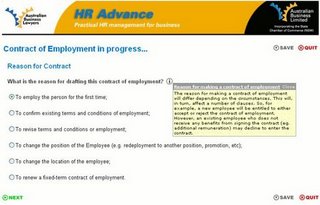
As the newly launched HR Advance service from Australian Business Lawyers and Australian Business Limited demonstrates, properly executed, online legal services can be very impressive.
In this case, anyone can create an employment contract in minutes, with the confidence that the final document will be fully compliant with Australia's new WorkChoices legislation.
Disclosure: The HR Advance site is built on Exari technology, so I could be accused of lacking objectivity. Please judge for yourself.
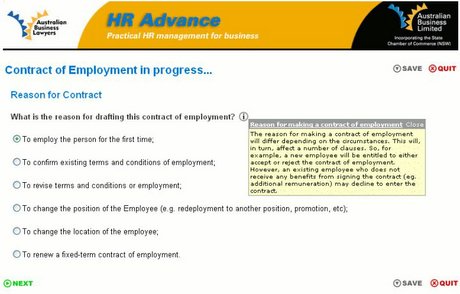
As the newly launched HR Advance service from Australian Business Lawyers and Australian Business Limited demonstrates, properly executed, online legal services can be very impressive.
In this case, anyone can create an employment contract in minutes, with the confidence that the final document will be fully compliant with Australia's new WorkChoices legislation.
Disclosure: The HR Advance site is built on Exari technology, so I could be accused of lacking objectivity. Please judge for yourself.
Tuesday, April 18, 2006
Is Your Procurement Team Best in Show?
Actually, "Best in Class" is the term they use in Aberdeen Group's report Contract Management Benchmark: Procurement Contracts. To make the grade, you need to have clearly defined and enforced procedures and policies, using automated systems company-wide as well as standard contract language. You also need to have 90% compliance between your purchases and your contracts. Does this sound like you?

Unfortunately, according to Aberdeen, only 1 in 5 make the grade.
Some of the more interesting revelations in this report are:

Unfortunately, according to Aberdeen, only 1 in 5 make the grade.
Some of the more interesting revelations in this report are:
- It takes 20 to 30 days on average, for a company to create, negotiate, and finalize a contract after the initial sourcing cycle is complete
- About 80% of companies are still using manual processes (with maybe the odd Access database thrown in)
- Only 17% of companies have one part of the business specifically designated to manage procurement contracts
- About 27% plan to invest in a commercial contract management solution within 24 months
- Pressure to better assess and mitigate risk is the key driver for contract management initiatives
Subscribe to:
Posts (Atom)