Friday, June 30, 2006

Aberdeen Does Sales Contracts

What better time than end of quarter to reflect on the fun of writing sales contracts in a mad rush. The sales team wants to close the deal. They don't want to wait two weeks for legal and miss their quarter-end target. They want their bonuses. Can't we just delete that pesky clause and sign?


Such are the challenges of sales contract management, on which the Aberdeen Group recently had this to say:
  • Sales contracts are highly labor-intensive, requiring frequent drafting, review, negotiations and approval.
  • It's difficult to ensure that standard language and pricing structures are followed, and to keep track of clauses used, especially if sales teams have a hand in the drafting.
  • Enforcing terms and clauses pre-approved by legal can significantly reduce risk, but is hard to do when a company is using only partially automated processes.
  • Best in class companies that do automate the process can lower their contract cycle times to the point where they are three times faster at closing deals than their competitors.
  • 46% of companies see the enforcement of standard contract terms as a top strategic action for contract management.
  • Companies are looking primarily toward the on demand, hosted model, which is lower-cost, more user-friendly and works well for sales teams scattered across different regions.
Who knows, with a bit of automation, next quarter might be your biggest yet.

For more details, get yourself a copy of The Contract Management Benchmark Report: Sales Contracts, April 2006.

Wednesday, June 28, 2006

Political Sole-Sourcing

In what appears to be a classic case of local vendor bias, Canadian transport manufacturer Bombardier, Inc. has found itself in hot water over sole-source contracts with two separate municipal authorities. Both deals are political, with Bombardier's promise of local jobs seeming to influence the decision not to go out to public tender.


One contract involves the supply of 234 new subway cars to the Toronto Transit Commission, with rival Siemens claiming it could do the job C$100M cheaper by manufacturing offshore.

The other contract is a C$1.2B deal with the Quebec government to replace Montreal's ageing fleet of 336 subway cars. Rival French vendor Alstom SA is challenging the Montreal subway deal in court. "We are of the opinion that the law calls for an open bidding process for any public transit equipment or material valued at more than $100,000" said Alstom Canada spokesman Pierre Renault.

The Montreal dispute should be of interest to government procurement teams worldwide, as it deals with a fairly universal question: what happens if we don't follow our own procurement rules? You end up in court is one answer. What happens next remains to be seen.

Monday, June 19, 2006

Paperclips Are Like, So Last Year

That's right. A career in procurement no longer means you're "in charge of paperclips". In somewhat provocative terms, the Financial Times (subscription required) reckons that procurement has undergone a revolution. It's no longer a career dead-end. No longer a mere support service. The modern procurement department is experienced, professional and respected, and it's being unleashed on an ever wider array of goods, and services. Not just stationery, furniture and laptops, but lawyers, accountants and consultants.


But at the same time as procurement spreads its wings to tackle services, it's also getting more sophisticated. The best procurement teams know that a good deal on services is not just about getting the lowest price. Sure, price matters. But in services, relationships matter too. As Gartner VP Mark Hollands writes for CIO, "the relationship will determine the success or failure of a deal, not how little you managed to pay." His advice to CIOs: don't screw your supplier too hard to the floor - it can be a career limiting move in the medium to long term.

One risk with doing bottom dollar deals is that you might fall victim to what Hollands calls "land and expand" strategies. Vendors take a bath on the first deal to get a foot in the door, then cast their net for more profitable work to recover their losses. Over time, the A Team is replaced with F Troop, as big vendors feel the pressure to hit their own profitability targets.

So the challenge for the procurement team is clear. Use your skill and knowledge to get a good price and deliver savings. But don't squeeze so hard that good relationships turn into unpleasant, adversarial ones.

Tuesday, May 30, 2006

Spending Public Money Wisely

Public procurement has been in the spotlight this month, and for good reason. We like to think our taxes are being well spent. As Jeff Kennett put it:

"If people want to mess up their own money, that's fine, but when people are spending public money, they have got to be accountable."


Having achieved savings of 30% under current procurement rules, the EU is now looking for additonal savings through new procurement policies. Even the 5% improvement estimated to be made through e-procurement translates into very large savings, when you consider the numbers involved:
  • Total public sector procurement across the EU15 countries is EUR 1,500 billion
  • Total spend is equivalent to the GDP of France
  • Total spend is more than the annual global sales of the automotive industry
Greater use of competitive tendering has been a big contributor to savings achieved thus far. The number of invitations to tender doubled between 1995 and 2003, and currently stands at 113,000 notices per annum.

One of the new EU proposals likely to cause a stir is the introduction of a standstill period of, say, 10 days, between publication of a contract award and the date of signature. The idea is to give aggrieved parties (ie, losing tenderers) the chance to challenge a decision before it's actually signed, so there's a greater chance of finding a pre-contractual remedy. Under the proposal, contracts signed during the standstill period would be wide open to challenge for a period of 6 months.

Friday, May 26, 2006

The $70 Million NDA

What's the value of a good NDA? About $70 million if your name is Scott Van Dyke. In 2003, his company, Anglo-Dutch Petrolem, won a $70.4M damages claim against US oil giant Halliburton and Scottish oil exploration and development firm Ramco. This month, with a Texas court ordering it to hand over various assets, Ramco is struggling for survival.


In a nutshell, Halliburton and Ramco had both signed up to an NDA with Anglo-Dutch, supposedly to help it develop oilfields in Kazhaksthan. Van Dyke had been searching for Noah's Ark in Turkey during the 1980's when he met Turkish president Turgut Ozal, who later introduced him to the Kazhakstan opportunity. Halliburton and Ramco were found to have breached the NDA by providing confidential Anglo-Dutch information to another company, Golden Eagle, who used it to grab control of the project. At the end of all this, Anglo-Dutch was left out in the cold, with no interest in the oilfield.

Don't let anyone tell you NDAs have no value.

Wednesday, May 24, 2006

Check Less, Improve Compliance?

With the FSA's deadline for contract certainty looming, Lloyd's is putting a positive spin on its latest initiative to "streamline the way insurance contracts are checked, produced and issued." The goal, of course, is to produce insurance documentation without any mistakes, and to issue that documentation to the customer before (or very soon after) inception.


The current (self) assessment of contract certainty amongst Lloyd's Managing Agents is 80%. That sounds OK, except that it means 1 in 5 deals flowing through the Lloyd's market is currently failing the contract certainty test.

The proposed solution? Simple, really. Check less.

It's hard to argue that slashing the number of QA checks from 170 to around half that number won't reduce the slip rejection rate. But whether this will improve the speed, quality and certainty of documentation is much less clear.

Monday, May 08, 2006

Death by Laptop

For those of us enjoying the benefits of laptops and mobile storage gadgets, it's easy to overlook the risks. But as a recent article in Law Technology News ("Death by Laptop", May 8th, 2006) points out, the risks are high, and the consequences of ignoring them rather scary. They cite two headline grabbing incidents to drive the point home:
  • Thief nabs backup data on 365,000 patients from a Providence Health Systems employee's car, and
  • Laptop stolen from employee of Fidelity Investments with data on 196,000 Hewlett Packard workers.
Which got me thinking about the risks of keeping highly confidential contracts and agreements on a personal laptop, and the consequences if it falls into the wrong hands. For lawyers working on confidential M&A deals, the fallout could be disastrous. For government contracts it's a recipe for public scandal. It doesn't take much imagination to conjure up other scary scenarios.


It does, however, bring into focus one of the benefits of web-based systems, where your confidential data lives on a server, safely out of range of the average laptop thief. You can still use your laptop to login and do your work, but if you happen to leave it in a taxi, or under the bar, your worst case scenario is the price of a new machine. Much better than waking up the next day to find yourself as front-page news.

Tuesday, April 25, 2006

Innovate, Commoditise or Retire?

The "C" word is starting to catch up with law firms, it seems. Commoditisation, I mean. The process by which nice, profitable, bill-by-the-hour work becomes not-so-nice, unprofitable, fixed-price drudgery. Legal futurologist Richard Susskind has been talking about it. Some firms have retreated from it. And after years of ambivalence, any lawyer with a career horizon longer than five years is starting to worry about it. Is someone going to commoditise me?


Commoditised lawyer... will work for food

Unfortunately, for many lawyers, the answer is yes. Sure, there will always be full-fee, high-end, high-value transactions and disputes to keep the wolves from the door (and the Dom Perignon flowing). Legal rocket science, if you like. But clients don't just need help with their rockets. They need to keep their trucks and cars running smoothly, too.

Tim L'Estrange, Senior Counsel, ANZ Bank, used a different analogy to say pretty much the same thing (Judgement day: lawyers feel heat over costs, service, AFR 16/5/2005):
We almost have too many hotels at the Sheraton and Westin end of the market and not enough at the Travelodge end.

While clients may be happy (or at least willing) to pay rocket scientist rates (or Westin rates) for things like complex mergers and acquisitions, high risk litigation, innovative financial products and other ground-breaking lawyering (the rockets), they don't like paying those rates for repetitive, lower-risk, lower-value transactional work (the trucks and cars) where fat fees do not represent good value.

But they do need help with their cars and trucks. Clients need to manage risks across all parts of their business. Even small transactions can deliver big liabilities in the wrong circumstances.

So, with an eye on value, and a growing awareness of how systems and technology can be used to deliver streamlined services at fixed (and fair) prices, clients are demanding more from the firms they deal with. If they know something isn't rocket science, and that it could be delivered in a smarter, more cost-effective way, it won't be long before they expect their preferred firms to deliver.

As one managing partner recently put it (Living in a commoditised world, ALB 3.10):
Commoditisation is what clients think about what we do.

Commoditisation is also the inevitable result of market forces. What do clients care most about? According to a recent survey of US companies, "client focus" (41%) and "good value" (20%) were the stand-out reasons why GCs would recommend a law firm.

How can you improve client focus and deliver better value than your competitors?

Not by wasting valuable time re-drafting and re-negotiating obscure clauses that clients don't care about. Not by cranking up hourly rates across the board.

A better way to show client focus is to streamline and automate repetitive work so that it can be done quickly and consistently by junior staff, allowing the senior lawyers to spend a much larger proportion of their time working closely with the client and helping them with the issues they value the most.

A better way to show value is to be the first to offer a packaged, fixed price solution to a problem your clients would love to solve, at a cost aligned to the value of the solution.

Which begs two questions. Which of today's pay-by-the-hour work will be tomorrow's commodity? And when will it happen?

According to Susskind, anything that can be systematised, probably will be:
If you find yourself in a practice area which you can imagine, hand on heart in the small hours of the morning when you wake up in a cold sweat in bed thinking about it, that “actually what I do is highly process-based and I can well imagine that being systematised” – if you can conceive of it being systematised, I think it will be systematised.

To my mind, the key question to ask for commercial/transactional work is this: Are the issues I negotiate and the documents I prepare for transaction X starting to follow a predicable pattern, most of the time? If there are predicable patterns to the commercial deal, the allocation of risk, the negotiations and the documents, then it is probably only a matter of time before it is commoditised.

A recent example that springs to mind is employment contracts, which many Australian companies will be reviewing in light of regulatory changes to workplace law. One firm, Australian Business Lawyers, is already offering a self-service, online solution to those who want a compliant agreement at a fixed (and fair) price.

Other examples might include routine loan agreements, mortgages and other securities documentation, shareholders' agreements, non-disclosure agreements, debt-recovery, software licences, consultancy agreements, real estate leases, etc.

How soon will it happen? It seems to be happening already. As Tony Williams (former Managing Partner of Clifford Chance and Andersen Legal) says in this article from Legal Week (17/11/2005):
...the tools to help firms change are available now. If they use them quickly and effectively, firms have every opportunity to beat off the new competition, to respond to the general counsel’s needs and to remain very profitable, at least in the medium term. You can do nothing - but only if you intend to retire within the next five years.

Innovate, commoditise or retire? Interesting choice.

Now would be a good time to read (or re-read) Clayton Christensen's classic, The Innovator's Dilemma. Or, you can cheat and read Bruce MacEwen's potted summary on his blog, Adam Smith, Esquire.

Monday, April 24, 2006

Employment Contracts Made Easy

Some people are skeptics when it comes to online delivery of legal services. They don't think a machine can do the same job as a well-trained lawyer. But this probably has more to do with the quality of many online legal solutions, than with the concept of online legal services per se. Why is a bad machine - which asks stupid, unhelpful or confusing questions - any worse than a bad lawyer - who asks stupid, unhelpful or confusing questions?


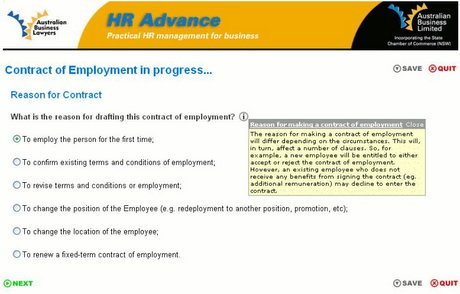
As the newly launched HR Advance service from Australian Business Lawyers and Australian Business Limited demonstrates, properly executed, online legal services can be very impressive.

In this case, anyone can create an employment contract in minutes, with the confidence that the final document will be fully compliant with Australia's new WorkChoices legislation.

Disclosure: The HR Advance site is built on Exari technology, so I could be accused of lacking objectivity. Please judge for yourself.

Tuesday, April 18, 2006

Is Your Procurement Team Best in Show?

Actually, "Best in Class" is the term they use in Aberdeen Group's report Contract Management Benchmark: Procurement Contracts. To make the grade, you need to have clearly defined and enforced procedures and policies, using automated systems company-wide as well as standard contract language. You also need to have 90% compliance between your purchases and your contracts. Does this sound like you?


Unfortunately, according to Aberdeen, only 1 in 5 make the grade.

Some of the more interesting revelations in this report are:
  • It takes 20 to 30 days on average, for a company to create, negotiate, and finalize a contract after the initial sourcing cycle is complete
  • About 80% of companies are still using manual processes (with maybe the odd Access database thrown in)
  • Only 17% of companies have one part of the business specifically designated to manage procurement contracts
  • About 27% plan to invest in a commercial contract management solution within 24 months
  • Pressure to better assess and mitigate risk is the key driver for contract management initiatives
In other words, as Aberdeen puts it, there are "temendous opportunities for improvement" in this area. Not just opportunities. Tremendous opportunities.

Wednesday, March 08, 2006

Billion Dollar Documents Back in Court

What's the price of an ambiguous insurance contract? About a billion dollars in the case of Larry Silverstein's policy over the World Trade Center's Twin Towers. That's a billion good reasons to get the fine print right.

one attack or two
One or two events that changed the world

Silverstein, the holder of a 99 year lease over the Twin Towers, and a syndicate of insurers that agreed to cover the property, were back in court this week, with both sides continuing their fight over the question whether the September 11 attack on the buildings was one event or two. If the two planes were a single incident, the insurers pay one amount. If the two planes were two separate incidents, the insurers pay a larger amount. The difference? Over a billion US dollars.

The problem? At the time of the attack, the parties had not clearly agreed which policy wording should apply.

In 2004, one jury decided that insurers who had agreed the Wilprop form could rely on wording that defined the attack as a single event. Another jury decided that insurers who didn't agree the Wilprop form were required to pay out on two events.

Now, both side are appealing.

It pays to get the fine print right.

Friday, March 03, 2006

Cronyism on Steroids?

When it was discovered that only four out of sixty contracts signed with a pair of external consultants went out to tender, New Zealand MP Murray McCully accused the Health Ministry of "cronyism on steroids". Now he reckons the Auditor-General's report on the matter portrays a saga of "incompetence on a monumental scale".


Tell us what you really think, Murray.

The Report doesn't paint a pretty picture of procurement policy compliance within the Ministry. Amongst Auditor-General Kevin Brady's many findings are these gems:
  • Most officials did not have a copy of the procurement policy.
  • Most officials were somewhat vague as to where they might locate a copy.
  • There was a general lack of awareness among officials as to what the policy actually required.
What conclusions can we draw from all this? Perhaps the obvious one is that producing a nice fat policy on something is no guarantee that anyone will follow it.

So how do you get people to follow procurement policy?

Despite making 17 recommendations for improvement, the Auditor-General missed one obvious point. That making people aware of a policy is still no guarantee they will follow it. This is particularly true when the policy is long and complex, and the time available to learn and understand it is limited. Another approach, and one which some government agencies are starting to adopt, is to develop procurement systems that guide users naturally toward compliant outcomes.

Monday, February 27, 2006

The Case of the Disappearing Contracts

Apparently 75% of US companies can't find 90% of their contracts. Gone. Missing. Lost. This is one of the more sensational stats to be found in a recent article on post-contract management at SupplyManagement.com. It's an interesting look at who's doing what when it comes to managing contracts once the ink is dry.


At last... the missing contracts

A common theme seems to be the disconnect between procurement experts who negotiate the contract, and the technical people who manage its performance. Contracts are signed, put in the bottom drawer, and never looked at again. The article cites one example where a London based financial services company was overcharged £15 million over 12 months because it failed to reconcile invoices against the negotiated terms of the contract.

With quotes and examples from o2, British Airways, Novell, Eli Lilly, Adecco, HM Prison Service and University College London, there's an interesting mix of ideas for improving contract management.

Friday, February 24, 2006

Technical Breach OK?

According to a report in today's Australian Financial Review (In breach but in with a shot, 24/2/2006, p12) sometimes it's OK for a vendor to employ a serving Defence Force employee to assist with a tender for a multi-million dollar defence contract. It might be a breach of departmental regulations, and presumably the conditions of tender, but according to the Inspector-General of Defence, it's only a "technical" breach. Apparently they're OK.

Since the officer had no connection to or involvement in the project for which tenders were called, the vendor received no improper or unfair advantage.

So, what did the vendor get for its $48,000 fee? Two months help with the bid. That's all.

Wednesday, February 08, 2006

Wanna buy some SOX?

Talk about over-used and abused. SOX compliance is one of those buzz words that just about eveyone has a "solution" for. Google "Sarbanes-Oxley" and you get over 27 million hits. Google "SOX compliance" and you get just under 5 million hits. That's a lot of hits. But what does it mean for your contracts? Or more specifically, what does it mean for your purchasing contracts?


Have I got an Act for you...

A recent article from SAP INFO got me thinking about these questions. Time to get a handle on what the Sarbanes-Oxley Act means for those who create and manage contracts on a daily basis.

If I'm buying a load of sox, do I need to worry about SOX?

For large US companies (and international companies who list in the US), the answer is yes, you do need to worry. In particular, it seems, you need to worry about section 404. Or if you don't, then your boss does.

Section 404 is all about internal controls for financial reporting:
  • management must establish and maintain internal controls;
  • management must assess whether they're working;
  • management must report on all this in the company's annual report;
  • the auditors must report on management's report.
So, when you go buying sox (or anything else for that matter), the executive suite needs to be able to say that there are adequate controls in place to ensure that your contracts don't mess up the company's financials. They need to know that you can't just go and buy sox worth $100 million when the company only needs $100 worth. Or that if you buy sox that turn out to be a fire hazard, the contract passes that risk on to the company responsible. If there are no such controls, and they have no idea what risks and liabilities are buried in your purchasing contracts, then they need to report on those weaknesses and have the auditors tick off that report.

One firm that paid a heavy price for weak internal controls is Adecco, a global temp agency with about 700,000 employees and annual turnover of $20 billion. According to a report in The Economist (19 May 2005), material weaknesses in Adecco's 2003 accounts meant that the auditors refused to sign-off without first checking every single transactions worth over $100. Six months, 160 auditors, 15 law firms, and $120 million in fees later, the accounts were signed off. In the words of Adecco's John Bowmer "It was a fee fest". Ouch.

Tuesday, January 24, 2006

Dis-Kinnected

Contract certainty may be a major problem for the London insurance market, but Kinnect is no longer part of the solution.

Despite investing several years and many millions of pounds in its Kinnect insurance trading platform, Lloyd's has now decided to shut it down.

Breaking 300 years of face-to-face, pen-on-paper contract negotiation tradition was never going to be easy.

More on this later...

Avoiding Contract Scandals 103

When the blame game begins, ignorance is rarely a good defence. It does, however, seem to be a very popular defence. Which brings us to the third lesson in this series.

Lesson 3:

Don't stick your head in the sand when your contract prices mysteriously go up, just as market prices around you are going down.

There's another name for prices that seem too good to be true: kickbacks. And with AWB accused of kicking back around $300 million to Saddam Hussein's regime, everyone wants to know who knew.

Not me, says AWB boss Andrew Lindberg. He has no recollection of puffing up the price of wheat contracts in order to funnel cash from the UN oil-for-food program back to the former Iraqi regime. After four days of questions, and around 200 "can't recall" answers, counsel assisting the special inquiry had this to say:

"It's ridiculous to suggest that you did not know, Mr Lindberg. Are you a complete fool?"

The inquiry continues.


Lindberg can't recall

Avoiding Contract Scandals 102

As the old saying goes: It takes two to tango. Which brings us to the second lesson in our contract scandal series.

Lesson 2:

Don't offer a cushy job to the procurement official who just awarded you a contract at an inflated price.

Failure to heed this lesson cost former Boeing CFO, Michael Seers, his job. And it landed him a four month prison sentence. All because he offered Darleen Druyan a job at about the same time she awarded his company a $23 billion contract.


Sears cops 4 months

Avoiding Contract Scandals 101

When a contract scandal breaks, everyone ducks for cover. Who broke the rules? Who knew? Who should have known? Whose heads will roll? The media shines a bright light into the darkest corners of the deal, looking for someone to blame.

There are two classic targets when the blame game begins. Those who did the dodgy deal, and those who should have stopped it but didn't. The former look corrupt. The latter incompetent.

Using two recent contract scandals as a guide - the Boeing Tanker Aircraft scandal, and the AWB Wheat-for-Oil scandal - we've come up with some simple lessons for staying out of trouble.

Lesson 1:

Don't take a cushy job at the company to which you just awarded a contract at an inflated price.

Failure to heed this lesson cost Darleen Druyan 9 months in prison. The former Air Force procurement official had awarded a $23 billion tanker aircraft contract to Boeing as a "parting gift", just before she went off to work there.


Druyan in happier times

Friday, January 20, 2006

Sign Here Please...

For most people, the task of creating and negotiating contracts was transformed some ten years ago, when email "tipped" and became the preferred mode of business communication. Drafts are prepared in Word, then emailed back and forth. Most of the time, changes are marked up (although sometimes not, but that's another story), and eventually a final version emerges, ready to sign.

It's at this point that things go decidedly low-tech. Despite much e-signature talk and buzz over the years, the task of signing contracts still seems to happen with pen, paper, fedex and fax.

But where do you look when, 6 months down the road, a dispute is looming, and you want to check the final terms of the contract you signed? Do you trust the last electronic copy buried deep in your email archives, or do you go rummaging around for the signed piece of paper?

This simple problem - keeping a signed digital copy of the final contract in one central place - is what EchoSign hopes to solve with a new web-based service.

All you do is browse to EchoSign, upload your final contract, tell it who needs to sign, and the contract is emailed to all relevant parties. They print, sign, and fax it back to your EchoSign number, and the final signed versions are stored as PDFs for future reference. Easy.